
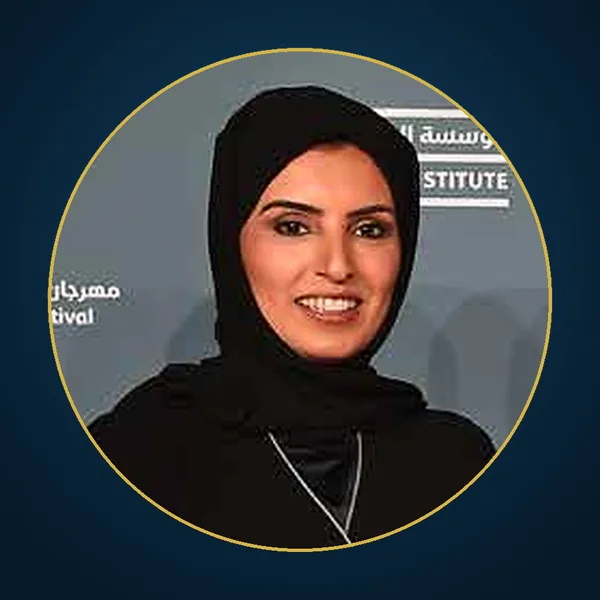
Fatma Al Remaihi
She pursued her calling until cinema became her world, creating space for talent and cultural bridges to audiences beyond Qatar.
2022 edition · source pages 220–225
At a Glance
Fatma Hassan Al Remaihi is Chief Executive Officer of the Doha Film Institute since 2014 and cultural adviser to the first Doha Tribeca Film Festival.
Searching for the Right Vocation
Her work received international recognition through selection among a group of 500 influential business leaders in the global entertainment industry and inclusion among fifty women leaders in the first International Women’s Report in 2018.
Her youth and the formation of her professional ambitions coincided with rapid change in Qatari society. Public investment in quality of life, youth empowerment and infrastructure encouraged her generation to seek roles that could contribute to the country’s progress and international standing.
After graduating from Qatar University in 2000, she spent a year considering where her abilities could be used. Her first position came in 2001 at the Supreme Council for Family Affairs. Three years later, she moved to the Amiri Diwan, where she remained for about eight years and managed projects including the Diwan library and the new Diwan building. The work developed her project-management and communication skills, but did not answer her longstanding interest in cinema and the arts.
In 2009, a newspaper report announcing a film festival in Qatar prompted her to pursue that interest directly. She joined the founding team of the Doha Film Institute and entered the field she had followed since childhood. Cinema became the professional world in which she recognised both her purpose and her ambition.
Qatar’s support for women helped define her goals without separating them from family or cultural values. It gave her the confidence to treat women’s participation as an integral part of national development rather than an exception to it.
Cinema as a Human Message
Since becoming Chief Executive Officer of the Doha Film Institute in 2014, she has directed its strategy, supported film culture in Qatar and strengthened the position of Qatari cinema regionally and internationally. She also served as cultural adviser to the first Doha Tribeca Film Festival and played a pivotal role in establishing the institute’s strategic partnership with the Giffoni Film Festival.
She directs the institute’s annual Qumra programme and Ajyal Film Festival, overseeing their creative, strategic and operational work. Both initiatives support a new generation of filmmakers, connect Qatar with the international film community and create sustained relationships with leading practitioners.
Her approach to leadership rests on patience, careful judgement, experience, adaptability and flexibility. These principles, rather than haste, allow a team to meet demanding responsibilities efficiently.
Cinema also entered family life. Her four children developed a strong interest in film and became regular members of Ajyal’s youth juries, making the cultural work a shared source of curiosity rather than a role confined to the workplace.
Building Opportunity for Filmmakers
Through the institute’s initiatives, she has worked to strengthen Qatar’s international image and bring new cinematic voices to wider audiences. Support for emerging directors, alongside programmes that cultivate local audiences, has helped filmmakers turn ideas into completed work and encouraged a deeper appreciation of cinema within Qatar.
The institute works closely with young filmmakers, giving them guidance, access to international experts and mechanisms through which their work can reach the world. By the period documented in the source, it had supported more than 540 films from seventy countries as well as a substantial number of Qatari filmmakers and creative practitioners.
Cultural exchange is central to that mission. Film can give audiences a broader understanding of other beliefs, affiliations and experiences while revealing aspirations shared across difference. The institute’s year-round events also draw international visitors, contributing to tourism, hospitality and trade while helping a local film industry deepen connections within society and express Qatari identity on screen.
Her mother is one of the three women who most influenced the journey. Married young and raising five children, she nevertheless completed university and balanced employment with family responsibilities. Her diligence and practical support provided a model to which her daughter continues to return.
Her Highness Sheikha Moza bint Nasser offered another model through her commitment to change, motherhood and close attention to detail. Her Excellency Sheikha Al Mayassa bint Hamad bin Khalifa Al Thani reinforced the value of sustained ambition. Their examples helped guide the effort to build a strong community of filmmakers in Qatar.
Qatar on an International Screen
The work has required her to challenge cultural stereotypes surrounding cinema and narrower assumptions about women who lead cultural organisations. The growing presence and success of Arab women filmmakers has strengthened her determination to correct those views and support creative leadership.
Balancing professional and family commitments remains one of the most difficult issues facing working women. She proposed variable working hours and other measures designed to remove unnecessary obstacles, allow a stable family life and sustain high professional performance. In her view, institutional success depends on the ability of a leader and team, not on gender.
Her work received international recognition through selection among a group of 500 influential business leaders in the global entertainment industry and inclusion among fifty women leaders in the first International Women’s Report in 2018.
She continues to raise cinematic literacy and public appreciation of film while working directly with young filmmakers. The institute’s established programmes, partnerships and supported productions show the concrete progress already made towards those aims.