
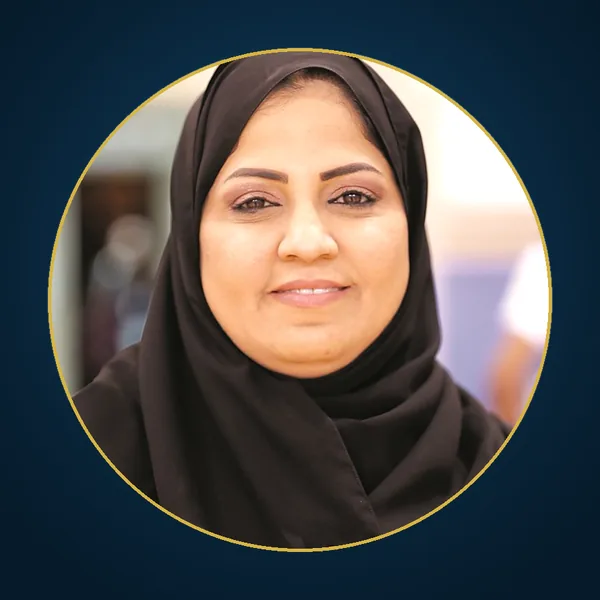
Ahlam Al-Mana
Adventurous and distinctive, she embraces discovery, new experiences and difficult challenges with intelligence, quick judgement and an enterprising spirit.
2022 edition · source pages 10–15
At a Glance
Ahlam Salem Al-Mana is a physical education specialist and former Chair of the Women’s Sport Committee.
An Upbringing that Nurtured Initiative
In 2013, she received the International Olympic Committee’s Women and Sport award following her decisive contribution to the first participation by Qatari women at the London Olympic Games.
Education as a Gateway to Public Service
She grew up in a traditional Qatari family with four brothers and five sisters and was the middle child. Her mother—may God protect her—taught her that no one should become detached from society: people should remain connected to others, respect customs and traditions, and understand that a woman’s success and independence do not require her to abandon the values of her community. Her father influenced her choice of sport through his confidence in her talent, his support and his pride. That foundation shaped her initiative and self-reliance and taught her to make the most of every opportunity to succeed and excel.
From Education to Women’s Sport
Family remained her highest priority throughout the different stages of her career, even amid heavy commitments and frequent travel. She refused to let work diminish her personal life and achieved a balance between the two with the help of her husband, who offered advice and guidance and shared both responsibilities and successes. A disciplined routine also helped: she organised her days carefully and made a point of gathering the family for lunch every day.
An Achievement Told through Evidence
Graduating in a discipline that matched both her passion and her talent was the first step. Yet she still felt that she had not been free to practise some of the sports she loved. Joining the Women’s Sports Committee therefore became a turning point in her career and a new experience for the community: it allowed her to give ambitious and talented young women the opportunities that had not been available to her. She regards receiving the international Women and Sport award as one of her most important achievements and a crossroads in her life, alongside Qatar’s participation in the London Olympics, which fulfilled a long-held dream.
London 2012: A Turning Point
Her acumen, intelligence and powers of persuasion helped her earn significant recognition. In 2010, Qatar received a letter from the International Olympic Committee suggesting that the country was not interested in supporting women’s sport. Knowing that this did not reflect reality, she set out to show the work Qatar was undertaking. She prepared a comprehensive report on the state of women’s sport and produced a video of no more than four minutes that addressed the questions being raised internationally and presented the wider picture. She screened it at a meeting of the Olympic Committee’s Women and Sport Commission before approximately twenty-eight leading members of the international sporting community, explained Qatar’s efforts and asked for their support ahead of the next Olympic Games. In 2012, Qatar sent a substantial group of well-prepared female athletes to London, drawing international attention to achievements made in record time. Their participation moved her to tears. Although the Qatari team did not win a medal, she considers taking part an important achievement in itself and an addition to the country’s record, particularly in women’s sport.
Two decades earlier, Qatari society was highly conservative, and entering a new field brought considerable challenges. Sport was widely regarded as a male domain with no place for women, so changing that perception became one of her greatest tasks. She earned the community’s trust and encouraged interest in women’s sport by respecting local customs and traditions, maintaining a dignified appearance and wearing the hijab at sporting events. She demonstrated that sport was not confined to a particular age, profession or social group: married women, engineers and doctors could all participate. Competitions involving parents also highlighted the commitment of Qatari women and encouraged more people to exercise. The establishment of Qatar’s National Sport Day became especially important to the committee because it supported its goal of making society more receptive to women’s sport and of presenting physical activity as a daily practice and way of life.
International Recognition and an Enduring Legacy
She passed her passion for sport to her children. Her youngest daughter was selected as a youth ambassador for the 2022 World Cup, while her eldest son won medals in equestrian sport at the international level over successive years. Her second son shares that passion. She regards equestrianism as a sport that builds courage, chivalry, self-confidence and dignity; she also sees it as a modest sport for girls and one firmly rooted in Arab culture.
The Hijab and the Right to Compete
She supported the Qatari team’s decision to withdraw from the seventeenth Asian Games in Incheon after its players were not permitted to compete in hijab, even though half the team wore it. For her, the hijab and the modesty of Qatari women are non-negotiable, and wearing it should not prevent participation in sport. Her efforts to secure Muslim women’s right to compete internationally in hijab continued after the incident. Working alongside the Qatar and Asian federations, and with the support of Qatar Olympic Committee officials, she helped present formal evidence showing that the hijab did not impede participation. In May 2017, the relevant international federation adopted a decision permitting athletes to compete in it.
A New Chapter, Continuing Expertise
She encourages young Qatari and Arab women to take part in a wide range of sports, although she has reservations about pursuing some of them professionally. She opposes sports that, in her view, expose a woman’s body or compromise her femininity, citing bodybuilding and combat sports. Whenever possible, she challenges the misconception that sport necessarily means roughness or imitation of men. She sees no contradiction between physical activity, femininity and tenderness and seeks to demonstrate that through the situations she encounters in life.
Family and Sport as a Way of Life
She believes that success and recognition do not arrive overnight but are the product of sustained time and effort. Reaching the summit requires steady progress, and people must experience failure to fully appreciate success. Difficult circumstances, in her view, should not weaken a person’s resolve; they should strengthen it and deepen the determination to reach a goal.