
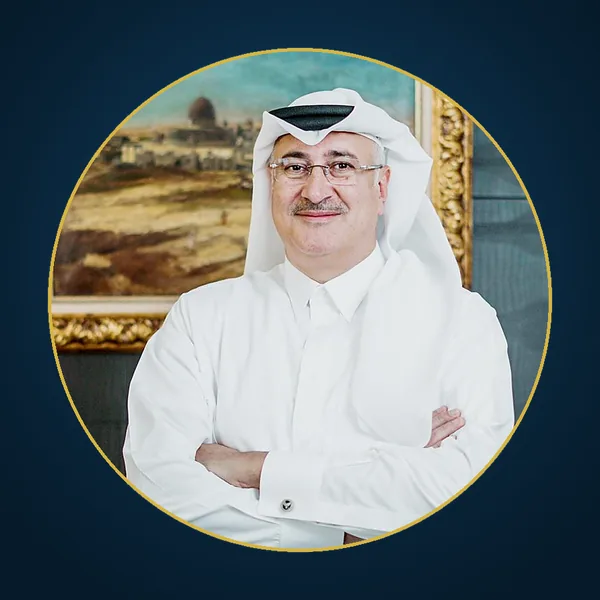
Ashraf Abuissa
A Qatari businessman who developed a family company into a diversified group while maintaining a sustained commitment to humanitarian and sporting work.
2024 edition · source pages 288–295
Profile
Ashraf Abdulrahim Abuissa is Chairman of Abuissa Holding, Vice-Chairman of the Palestine Children’s Relief Fund and a founding board member of INJAZ Qatar. He assumed responsibility for the family business at an early age and led its expansion in Qatar and across the region.
Childhood and Early Responsibility
He was born in Singapore while his father was there on assignment for Qatar Shell. He grew up in Al Riffa, east of Doha, in a traditional family of two sons and two daughters. After the family moved to Al Sadd in the mid-1970s, his primary education was divided between Abu Bakr Al-Siddiq and Tariq bin Ziad schools. He continued at Qatar Preparatory School and Al-Istiqlal Secondary School. He joined Al Sadd Sports Club at twelve, and his ability quickly became apparent. By fourteen, he was a leading player in the club’s youth basketball team and attracting considerable media attention.
His father combined wisdom, strength of mind and great humility and sought to instil the same qualities in his children. Before basketball training, he required he to work in the family shop beside Al Sadd Club. The boy tried to avoid the task because he felt embarrassed in front of his friends, but his father insisted precisely to teach humility. The lesson had a lasting influence on his character.
After secondary school, while still playing basketball for Al Sadd, he travelled to the United States for university study.
Returning to Education
His father died soon after he began studying abroad, compelling the nineteen-year-old to return to Qatar, care for his mother and younger siblings and manage the family business. The Blue Salon was then a small shop with a wholesale department in Al Sadd, founded only six months before his father’s death. Some employees tried to exploit his youth and limited experience, but he responded firmly: they could accept the company’s standards or leave. Most chose to remain. With advice from his uncle Mohammed in the United Arab Emirates, lessons in precision and strategy from Japanese partners, a French emphasis on reputation and commitment, and support from his brother, he transformed the Blue Salon from a small retailer into a prominent Middle Eastern group with more than 100 stores and 3,000 employees.
The circumstances that had forced him to abandon university left him with no expectation of returning. His mother nevertheless insisted that he complete his education. He waited until his younger brother Nabil graduated and could assume responsibility for the company, then resumed his studies and graduated from the American University in Atlanta. He also participated in Harvard University’s Owner/President Management programme.
Responsibility for the company revealed a natural commercial ability. He developed a plan and vision that went beyond importing and displaying international brands: the group would also manufacture, design and create products suited to local customers. He launched several distinctive concepts. Musafir became the first integrated travel-supplies retailer and expanded to neighbouring countries, the United States and Turkey under an Arab name. Karisma introduced a cosmetics and accessories concept directed at young women aged fifteen to twenty-five. Arabesque brought together sweets from across the Arab world, while AlBahie Auction House became Qatar and the region’s first specialist auction venue for antiques, art, watches, bags, amber, carpets and jewellery. He also founded “Wholesale”, Qatar’s first digital platform for bulk consumer and food products, household appliances and cosmetics, delivered to homes or shops. Other concepts included Falta for electronics and telephones, Secret Notes for perfume and Nest for antiques.
Building the Family Business
His ambition also led him to establish the Qatar chapter of the Young Presidents’ organisation, a global leadership community for chief executives of major companies. Headquartered in the United States, it brings together nearly 30,000 members in more than 130 countries to promote learning and international relationships.
Success in international business did not displace his commitment to humanitarian, charitable and voluntary work. He became a founding board member of INJAZ Qatar, which prepares young people for employment through practical programmes delivered with companies, educational institutions and corporate volunteers. The organisation belongs to the international Junior Achievement network. He also served as Vice-Chairman of the Board of the Palestine Children’s Relief Fund.
Although he did not continue as a player, he contributed to sport through Al Sadd Sports Club, first as head of its basketball staff in the 1990s and then as a member of the Basketball Federation’s Board of Directors. He supported the sporting careers of his sons and nephew at Al Sadd and also worked towards establishing the Qatar Polo Club.
Leadership and Community Service
Family stands at the head of his priorities, and he regards investment in his four children as his greatest. He surrounded them with care and encouraged good character, perseverance and determination. His eldest daughter, Haya, graduated with distinction in law from the University of Edinburgh and began training as a lawyer; she also represented Qatar in volleyball. His son Abdulrahim studied in the United States and later supervised the establishment of a major project to develop promising talent in basketball and other sports in Qatar. He organised several children’s basketball courses and hosted NBA professionals from the United States.
His son Sultan completed secondary education at the American School of Doha and continued his studies in the United States, where he joined his university’s basketball team. Tamim remained a pupil at the American School of Doha. All four children represented Qatar in national sports teams.
He had chosen neither his field nor the timing of his entry into it: circumstances imposed the major responsibility of continuing his father’s work when he had little experience. His life changed overnight, yet he made the Blue Salon an important presence in Qatar’s market. At first, international companies hesitated to work with someone so young and doubted whether he could establish their brands successfully. Once they witnessed his seriousness and diligence and saw that he could continue his father’s work, they entrusted him with representation in additional countries.
Crisis and Continuity
Covid-19 became another major challenge as retail stores around the world closed and in-person purchasing came to a standstill. He responded flexibly, adapted plans and intensified online retail. An e-commerce department established before the pandemic enabled a faster, stronger transition, limiting losses and helping the business pass through the crisis. Advance preparation and a move into medical supplies provided further resilience.
The 1990–1991 Gulf War became a decisive test for his company and, consequently, for his own life. Imports stopped and war risk pushed insurance costs to exceptional levels. Many companies closed or dismissed employees; he continued importing goods without insurance and retained his entire workforce. Because his company remained supplied while competitors did not, its market share increased. Preserving jobs during such a difficult period also deepened employees’ loyalty to the business.
The 2017 blockade was another painful turning point. The company had to close approximately eighty stores in the United Arab Emirates and Saudi Arabia, causing losses whose effects continued for years. Strong relationships and the company’s sound reputation led banks to respond responsibly and constructively, helping the group maintain commercial activity through the crisis. Its attention turned towards Qatar, where broad support for the local market was growing.