
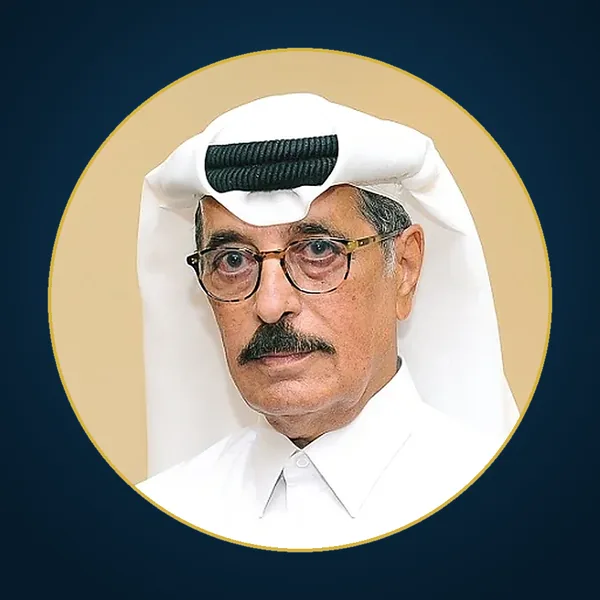
Hamad Al-Kawari
He built bridges between Qatar and the world, treating culture, diplomacy and knowledge as complementary forms of public service.
2024 edition · source pages 10–25
Profile
His Excellency Dr Hamad bin Abdulaziz Al-Kawari is Minister of State with the rank of Deputy Prime Minister and President of Qatar National Library. He served as Minister of Culture, Arts and Heritage from 2008 to 2016, represented Qatar as ambassador to the United States and France and as a delegate to UNESCO and the United Nations, and was Qatar’s candidate for Director-General of UNESCO in 2017.
Memory of Place and the Beginnings of Awareness
His path also intersected with that of Ahmad Sidqi Al-Dajani, a founder of the Palestine Liberation Organization who served on its Central Council until 1981.
About thirty thousand copies of ‘On the Destiny of the People of Determination’ were distributed across its three principal languages, including copies presented to heads of state and government, ministers and ambassadors.
His earliest memories belong to Al Ghariya, where the mountain, the sea and the sight of his mother returning with fresh water remained vivid long after the family left. Al Rumaila shaped his youth among relatives, neighbours, the mosque, the cemetery and the small local shops. In 1972, Umm Tamim entered his life as his wife and enduring companion.
Alongside formal schooling, he studied the Qur’an and religious sciences at Salah Al-Din School under Sheikh Abdullah Al-Ansari, then joined the Religious Institute when it opened. He first enrolled in the Faculty of Sharia at Al-Azhar University before moving to Dar Al-Ulum, where he earned a bachelor’s degree in Arabic and Islamic Studies from Cairo University in 1970. He later completed a master’s degree at Saint Joseph University in Beirut, studied political philosophy at the Sorbonne and received a doctorate in political science from Stony Brook University in New York in 1990.
The doctorate was a goal from the moment he arrived in New York in 1984. Stony Brook was more than four hours from Manhattan by car, and he travelled there twice a week while carrying diplomatic responsibilities. His dissertation, completed after more than three years of research, examined decision-making in the United Nations Security Council through the Iran–Iraq War as a case study.
After returning from university, he became head of Abu Bakr Al-Siddiq Primary School. When the Ministry of Foreign Affairs was established on 22 February 1972, he moved from education into diplomacy. His first assignment took him to Beirut as chargé d’affaires, preparing the embassy and residence for His Excellency Sheikh Mohammed bin Hamad Al Thani, Qatar’s first ambassador to Lebanon.
Scholarship Opens the Door to Diplomacy
Beirut taught him to respect pluralism and differing points of view. After the October 1973 War, he accompanied His Excellency Sheikh Suhaim bin Hamad Al Thani to Damascus for a meeting with President Hafez Al-Assad and wrote the minutes by candlelight during a power cut. The quality of that record helped shape the decision to appoint him ambassador to Syria in 1974.
Five years later he became Qatar’s ambassador to France, serving concurrently as non-resident ambassador to Greece, Italy, Spain and Switzerland. From 1984 to 1990 he was Qatar’s Permanent Representative to the United Nations and non-resident ambassador to Argentina, Brazil and Canada. He then served as ambassador to the United States from 1990 to 1992, with non-resident accreditation to Mexico and Venezuela.
Appointed Minister of Information and Culture in 1992, he introduced measures between 1992 and 1996 that supported press and media freedom and ended censorship of newspapers and publications, leading towards the closure of the Ministry of Information in 1997. That commitment was consistent with his later role in establishing the Doha Centre for Media Freedom in 2007.
In July 2008, he became Minister of Culture, Arts and Heritage. He chaired the seventeenth Conference of Arab Ministers of Culture in 2010, the year Doha was named Arab Capital of Culture. In 2012 he helped launch the Years of Culture initiative, beginning with the United Kingdom and continuing with Japan in 2013, Brazil in 2014, Türkiye in 2015, China in 2016, Germany in 2017, Russia and India in 2018, France in 2020 and the United States in 2021, with Qatar’s principal cultural institutions participating.
His institutional responsibilities included membership of the GCC Advisory Commission and the board of RAND-Qatar Policy Institute; co-founding and chairing the Board of Trustees of the Doha Centre for Media Freedom; chairing the organising committee for Doha, Arab Capital of Culture 2010; and chairing the Qatar State Award and Qatar State Award for Children’s Literature committees. He co-founded the Arab World Institute in Paris in 1980, joined the Qatari Businessmen Association in 2008 and served as Vice-Chairman of Al Jazeera Media Network, Managing Director and trustee of Qatar National Library, a trustee of Qatar Museums Authority and Co-Chair of Northwestern University’s advisory council.
His international service included representing Qatar at UNESCO and serving as Permanent Representative to the United Nations from 1984 to 1990. During that period, he was Vice-President of the fortieth United Nations General Assembly, chaired the Special Political and Decolonization Committee at its forty-second session in 1987, served as Vice-Chair of the Committee against Racial Discrimination and sat on the Dag Hammarskjöld memorial board. He also represented Qatar in the Non-Aligned Movement and served on the GCC Advisory Commission from 1997 to 2004.
Culture at the Heart of Public Service
In 2012, he chaired the thirteenth United Nations Conference on Trade and Development and was elected Honorary President of the twenty-fifth Universal Postal Union Congress. His attachment to French language and culture was reflected in his leadership of Qatar’s delegation to the 2012 summit of the International Organisation of La Francophonie in the Democratic Republic of the Congo, after Qatar was admitted as an associate member.
His United Nations years deepened his ties with African delegations. As acting chair of the committee opposing apartheid, he worked closely with representatives during the liberation struggles in Zimbabwe and South Africa. Those relationships remained important during his UNESCO campaign, when he visited African members of the Executive Board and received substantial support despite external pressure on some delegations.
He became President of Qatar National Library in April 2020. Under his leadership, the Library continued to document the history of Qatar, the Gulf and Arab and Islamic heritage while expanding digital access to knowledge. The Cultural Salon initiative, organised with Hamad Bin Khalifa University, exhibitions linked to the Years of Culture and agreements with major libraries and archives strengthened its local, regional and international role.
A defining partnership with the British Library digitised documents and photographs relating to Qatar and the Gulf. It produced Qatar Digital Library in October 2014, before the formal opening of Qatar National Library, and developed into the largest specialised digital repository on the history of the Middle East, offering nearly two million documents free of charge to users worldwide.
Cooperation agreements also connected the Library with the National Library of Türkiye, the Turkish Presidential Library, the Ottoman Archives, the National Library of Azerbaijan, the National Library of China, the Boris Yeltsin Presidential Library in Russia, the National Library and National Archives of the Netherlands, the National Library of France and New York University. Together, these partnerships widened access to documents and manuscripts concerning Qatar, the region and Arab and Islamic civilisation, making the Library an instrument of cultural diplomacy as well as scholarship.
The Library maintained its cultural activity during the Covid-19 pandemic by moving events online. It also supported the knowledge economy through access to global electronic resources, encouraged children to read, helped researchers use documentary heritage and served as the International Federation of Library Associations and Institutions’ regional centre for preservation and conservation.
Qatar nominated him for Director-General of UNESCO in 2017. He visited all 52 countries represented on the Executive Board and extended the campaign to 70 countries, meeting heads of state and government, ministers, university communities and the press with a programme focused on poorer nations. He led the first four voting rounds and reached a tie in the decisive stage before losing by a single vote. A telephone call from His Highness Sheikh Tamim bin Hamad Al Thani after the result helped turn disappointment into a documented lesson in perseverance.
A Library as Cultural Diplomacy
His public and cultural responsibilities have also included membership of advisory and cultural bodies in Qatar and abroad. Across those roles, he has consistently linked diplomacy with culture, media freedom, education and the circulation of knowledge.
Writing became another form of public service. His books include “The Controversy of Battles and Settlements behind the Scenes of the Security Council: The Iran–Iraq War”; “Incomplete Knowledge: Arabs and the West in a Changing World”, drawn from articles and lectures delivered between 1996 and 2008; and “On the Destiny of the People of Determination: An Intellectual Biography”. The last was translated into 10 languages, reached a second Arabic edition and accompanied his UNESCO campaign, with approximately 30,000 copies distributed in its three principal languages.
He also wrote “And the Injustice of Relatives: The Path to UNESCO”, a detailed account of the campaign that the source dates from 18 September 2019, and “Musafir Zadahu al-Jamal”, whose first volume grew from illustrated Instagram notes about people he had known. “Bridges, Not Walls: A New Approach to the North’s Relationship with the South”, published by Hamad Bin Khalifa University Press, examines the civilisational imbalance between North and South and was translated into Spanish, French, English, Persian and German.
In 2023, he published “Something of Me: Cultural Diplomacy after the Qatar World Cup”, examining the cultural impact of the first FIFA World Cup hosted by an Arab Muslim country. The book presents cultural diplomacy as an ancient practice rooted in earlier civilisations and argues that culture remains essential to relations among states.
His advocacy for freedom of expression extended beyond institutions. In 1994, he developed the Qatar Radio programme “Issues and Opinions” as a model of unusually open public discussion. The media dispute between Qatar and Saudi Arabia over Yemen that year reinforced the need for a stronger Qatari media presence and formed part of the background to the launch of Al Jazeera on 2 November 1995.
That commitment extended beyond institutions. He supported journalists and cultural initiatives and viewed Africa not as a distant region but as a source of enduring friendships, political insight and lessons in the pursuit of freedom and rights.
Experience as a Legacy for Future Generations
Many figures influenced his life and outlook, among them Dr Mohammed Al-Fadel, Dr Clovis Maksoud, Nassib Lahoud, Dr Ayman Taha Al-Rifai, Sheikh Ahmed bin Saif Al Thani, His Excellency Samir S. Shihabi, His Excellency Ismat T. Kittani, Abdalla Al-Ashtal, His Excellency Hédi Mabrouk, His Excellency Khalifa bin Abdulaziz Al-Mubarak and Ahmad Sidki Dajani. His diplomatic years also brought encounters with former French President Jacques Chirac, former Prime Minister Raymond Barre, former Foreign Minister Claude Cheysson, musician Mohammed Abdel Wahab, Egypt’s former King Fuad II, Ahmed Ben Bella and former Algerian President Abdelaziz Bouteflika.
Travel remained a source of knowledge, while photography became a way of observing the world. During the pandemic, he returned to the camera and photographed Ras Laffan, joining intellectual curiosity to an enduring interest in place and image.
His honours include the sash awarded by His Highness the Father Amir Sheikh Hamad bin Khalifa Al Thani in October 2017, an honorary doctorate from the University of Rome Tor Vergata in 2016, the title of Arab Heritage Man of the Year in 2016, France’s Order of Arts and Letters in 2014, the Legion of Honour in 1984 and the French National Order of Merit in 1980. He also received decorations from Jordan, Spain, Italy, Argentina, the Netherlands and Poland.
His children were born during different diplomatic postings: Iman in Beirut, Tamim in Damascus and Omran in France. All three completed master’s degrees at George Washington University, and Omran went on to earn a doctorate in energy and the environment.
Diplomacy also exposed him to danger and isolation. In San Salvador, he experienced an earthquake measuring 6.0 that lasted about ninety seconds while attending the inauguration of President Nayib Bukele. In New York in 1984, he confronted the demands of public speaking at the United Nations by undertaking three months of continuing education at New York University.
He considers his cultural record part of Qatar’s history and of the broader Arab and Islamic record. He therefore continues to document and publish his experience as a historical reference and a source of encouragement for younger generations, while advancing initiatives that serve Qatar and the wider human community.